Professional Experience
Partnerships | Sales | Marketing Convergence: How a multi-disciplinary approach creates competitive edge
Data is Neutral. Language is Not.
In my current role at Rippling, I work as an Account Manager on our Channel Partnerships team. I interact face to face with the customer every single day, at all times of the day. Recently, Rippling launched a major product expansion of Rippling AI.
Rippling’s advantage is that employee data lives within one centralized system, from payroll and benefits, to expenses, performance, employee feedback and more. That makes AI incredibly powerful. It also makes the language surrounding those insights unusually sensitive.
A part of Rippling AI launch meant a massive surge in marketing collateral and campaigns funneled to our current customers, urging product awareness, interest, and guiding clients further down the sales funnel. One of my particular Admins had become quite escalated from the verbiage found in an in-app advertisement for Rippling AI. The ad highlighted a specific amount of hours an employee had worked, 38, and followed this data point with, “Is this employee overworked? Tap to see who’s at risk of burnout.”
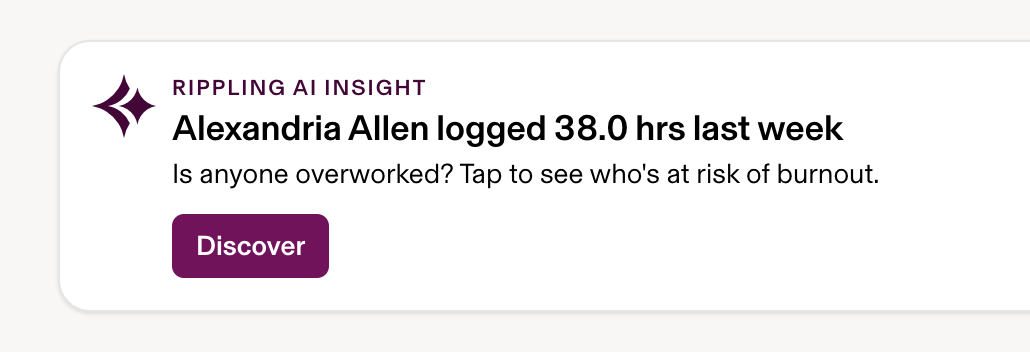
Upon further investigation, this specific employee was already taking some well deserved vacation time when the banner alerted. This only exacerbated the client’s defense. Although the advertisement presents the data, “38 hours” as a seemingly neutral data point, it simultaneously, interprets the conclusion of “overworked” or “burned out”.
The language became a trigger to how the CEO was managing his business and employees, rather than a useful display of product capability. Instead of recognizing the potential value AI could bring to his organization, the focus on the product launch became a battlefield for proving his own competence.
The big takeaway for me was, Data is objective, but the language around it rarely is. This experience has become a great demonstration on how emotional response can interrupt an intended marketing to sales business funnel.
The initial funnel transferred from:
Product awareness → curiosity → exploration → adoption
To:
Product awareness → perceived judgment → defensiveness → distrust
In hopes to rectify this swiftly, I alerted our internal teams & management to halt production of the in-app ads with this language. This was quickly course-adjusted.
Due to the nature of this industry, the data conveyed can be deeply sensitive and by default very emotional. If one thing is miscommunicated the story can take on different narrative in a matter of a second. Tarnishing the impact of a product release’ campaign, as well as overall trust of the client in Rippling itself.
This became a learning opportunity for how I think about constructing advertisements. There is a clear importance to look at the data conveyed holistically, rather than as an independent truth. For example, the client may have had an employee who worked significant hours in one week, like 38, but it is imperative to expand beyond this single data point, and cross examine other key metrics like time off balance, and PTO fulfillment prior to making a conclusion. Thus, impactful AI marketing requires contextual intelligence, not merely data intelligence. The danger lies when marketing copy turns isolated information, or correlation into a narrative of certainty.
Within my role, I have direct experience with the customer across multiple business segments. These experiences begin to perpetuate recognizable patterns— the buyer persona and their demographics typically indicate the meeting’s direction and the products they seek to discuss. In order for aligned product value to be recognized, and for the client to propel forward on the customer journey, at a micro level, each email cadence, and every meeting becomes a personal campaign of Rippling, but I am tasked to control of this framework live. Success then, requires immediate recognition of a client’s behavior and sentiment behind said product, and of Rippling as a whole. De-escalating clients, and positioning product value as an opportunity to convert to close-won, has become critical to my success. This being said, I have strong awareness for the insights that each buyer persona cares about, typically found within the problems and pain they experience.
Looking at same example of the in-App advertisement the Payroll data highlighted holds a strong sentiment, but the 38 hours worked alone doesn’t explicitly convey the direct risk to their payroll functioning / compliance. Most Admins are seeking assurance they are operating in terms of compliance, as a miss here, can have direct downstream impact on revenue i.e. potential fines. When looking at creating strategy for sales and marketing, following the money is a great asset to refining insights that clients deeply care and think about. If I were to take the same example of time-clock hours, but refining the language to highlight downstream impact I would suggest:
“Alexandria logged 38-hours last week. Work well done!
Tap here to stay in the know of who’s approaching overtime, before timecard hours turn into costly over-time corrections. “
Normally I wouldn’t immediately follow with a compliment, but keeping the tone light within this industry has done wonders through my experience. This formatting shows their customer data, while also showing them the administrative and financial consequence the data helps prevents. A common pain for CEO/HR leaders risk each time payroll is processed, is accuracy. My clients are always asking me, “how do I know if I’m operating in compliance?” The answer is never black and white, but utilizing AI as a compliance safe-guard not just within Payroll functions, but applied across all your employee data becomes invaluable to their operations, as it is a direct alleviation to their daily concerns and needs. This becomes especially useful for newer companies, or even newer Admins who may not be aware of the key datapoints to cross reference to avoid potential financial risk of payroll penalties. We can’t run Payroll for them on their behalf, but we can pinpoint the necessary insights that guide them towards operational compliance by alerting risk, and why this matters before it’s too late. Proving product value first hand.
Identifying recurring data themes found within the customer’s daily experiences & feedback, strengthens applicable buyer persona knowledge, which proves to be especially valuable when working with emotionally charged data, and refinement of marketing strategy. By creating a direct feedback loop between those reactions and the teams shaping the product narrative allows marketing to course-correct before a message becomes a story the brand never intended to tell.
As an Account Manager, I occupy a unique vantage point where I can observe whether marketing interpretations survive contact with the actual customer. By proxy, I can see where intended messaging and perceived meaning begin to separate, in real time. Marketing language doesn’t just describe a product’s capability, it can assign meaning, judgment, and the emotional stakes of the data being shown. As a result, data may be neutral, but the story we attach to it is not.
